Monday, April 30, 2012

Penfield (cont.) & Workshop

If you have not already done so, please submit one of your poems to the Penfield Poetry Contest. The deadline to do so is today (and it's required). Sign the paper in the front of the room with the name of the poem you submitted for participation credit.

You must save your work as a PDF or Word document (doc) file. Your name should NOT appear on the same page as the poem. A separate page with the contestant's (you) NAME, GRADE, SCHOOL, HOME ADDRESS, & PHONE # should be included on the cover page. The poem should not have a heading, but should have a title. Send your entry to: lgrills@libraryweb.org and enter POETRY CONTEST in the subject line of the email.
During 7th period, please prepare for your workshop 8th period. Any assignments or writing you have not completed, please complete. Print out enough copies for your workshop group.

During 8th period, please gather in your workshop groups and workshop any piece of writing you would like to workshop. After your workshop, go back and revise your work based on what you feel needs to be changed.

PORTFOLIO: Please label your assignments and place them in your portfolio (or if you've already printed them out, please label your assignments so that it is clear what assignment you wrote the work for). If this is a second or third or fourth draft, please indicate that on the paper. You should have various second or third drafts in your portfolio by now. Check the previous posts (from March and April) to determine what assignments and work we did this marking period.

HOMEWORK: Please continue reading Cat's Cradle. Aim to complete this book by Friday.

Thursday, April 26, 2012

Penfield Poetry & Cat's Cradle

To start off today's class, please take the next 15 minutes to read Cat's Cradle and complete the half-sheet observation form. This is participation credit.

So far in Cat's Cradle (a bit of summary):

At the opening of the book, Jonah, our narrator, is writing a book about what happened on the day the atomic bomb was dropped on Hiroshima. While researching this topic, John becomes involved with the children of Felix Hoenikker, a fictional physicist who helped develop the atomic bomb. John writes to and then interviews the Hoenikker children and others connected to the creation of the bomb.  He meets Dr. Asa Breed, who was Hoenikker's supervisor and learns of a substance called ice-nine, now secretly in the possession of his children. Ice-nine is an alternative structure of H20 that allows water to become solid at room temperature. When a crystal of ice-nine contacts liquid water, it makes the molecules of liquid water arrange themselves into the solid form (ice-nine).

John and the Hoenikker children eventually end up on the fictional Caribbean island of San Lorenzo, one of the poorest countries on Earth. The island is ruled by the fictional dictator, "Papa" Monzano, who threatens all opposition with impalement on a giant hook.

Characters include:
  • John, also known as Jonah, the narrator
  • Felix Hoenikker is the "Father of the Atom Bomb."
  • Dr. Asa Breed is Felix Hoenikker's supervisor. He takes the narrator, John, around Illium and to the General Forge and Foundry Company where the late Felix worked.
  • Newton "Newt" Hoenikker: The midget son of famed scientist Felix Hoenikker, and a painter. He is the brother of both Frank and Angela Hoenikker. His main hobby is painting minimalist abstract works. He briefly had an affair with a Russian midget dancer named Zinka, who turned out to be a KGB agent sent to steal ice-nine for the Soviet Union.
  • Emily Hoenikker is Felix Hoenikker's wife, who died giving birth to Newt.
  • Franklin "Frank" Hoenikker is Felix Hoenikker's son, and Major General of San Lorenzo. He is the brother of Newt and Angela Hoenikker. He is an utterly technically-minded person who is unable to make decisions except for giving technical advice. His main hobby is building models.
  • Angela Hoenikker Conners is Felix Hoenikker's daughter and a clarinetist. She is the sister of Frank and Newt Hoenikker, and is married to Harrison C. Conners. In contrast to her midget brother, Angela is unusually tall for a woman.
  • Bokonon co-founded San Lorenzo (along with Earl McCabe) and created the religion of Bokononism, which he asked McCabe to outlaw. If you want something to be popular, try banning it.
  • Earl McCabe co-founded San Lorenzo.
  • "Papa" Monzano is the dictator of San Lorenzo.
  • Mona Aamons Monzano is the adopted daughter of "Papa" Monzano. She is considered "the only beautiful woman on San Lorenzo."
  • Julian Castle is the multi-millionaire ex-owner of Castle Sugar Cooperation, whom John travels to San Lorenzo to interview.
  • H. Lowe Crosby is a bicycle manufacturer John meets on a plane to San Lorenzo. His main goal is to move his factory to San Lorenzo, so he can run it with cheap labor.
  • Hazel Crosby is the wife of H. Lowe Crosby.
  • Philip Castle is the homosexual son of Julian Castle, and the operator of the hotel Casa Mona on the island on San Lorenzo.
  • Horlick Minton is the new American ambassador to San Lorenzo, whom John meets on a plane. He was blacklisted as a Communist sympathizer during the McCarthy-era.
  • Claire Minton is the wife of Horlick Minton.
After answering any questions you may have about the novel thus far, please use the time in the lab to complete any writing you would like to include in your portfolio this marking period, as well submit a poem to the Penfield Poetry Contest. See posts below for details.

HOMEWORK: Submit a poem to the Penfield Poetry Contest (required). Continue reading Cat's Cradle.

Tuesday, April 24, 2012

Penfield Contest, Portfolio & Pamela Houston Draft

Today in the lab please complete the following tasks:

1. If you have not yet completed DRAFT ONE of your Pamela Houston draft, you are late and need to complete this draft today. Print and put your draft in your portfolio when you have completed it.

2. Work on the Vonnegut advice revision. See post below for details. Please complete ANY draft of ANY assignment you have worked on this marking period. Use the time in lab today to complete your previous or revised drafts. Some suggestions might include: The Ray Bradbury story draft, any workshopped or revised draft, Madonnas of Leningrad, closed poetry form, open poetry form drafts, ekphrastic poetry drafts, nature poetry drafts, everyday poetry, internal monologue, tense draft, etc.

3. Prepare ONE poem you've written this year (that you like enough to send it to a contest) and send it electronically to the PENFIELD POETRY CONTEST. You must save your work as a PDF or Word document (doc) file. Your name should NOT appear on the same page as the poem. A separate page with the contestant's (you) NAME, GRADE, SCHOOL, HOME ADDRESS, & PHONE # should be included on the cover page. The poem should not have a heading, but should have a title. Send your entry to: lgrills@libraryweb.org and enter POETRY CONTEST in the subject line of the email. Deadline is MONDAY, April 30. But do this today or Thursday so you don't forget!

4. With time remaining, please either:
A. Read Cat's Cradle
B. Write a poem. Write a story. Write a play. Write a... you get the idea.
NOTE: Many of you have not yet turned in your book review. This is past due and will affect your overall grade (even if you chose to read the entire book). Please complete this assignment on your own time.

Friday, April 20, 2012

Revisions & Cat's Cradle

During period 7, we will be discussing and reading Cat's Cradle. Please read silently for the next 10-15 minutes. As you read, please take notes on the handout. After our activities, we will return to the lab.

Please take a moment today to review the tips Vonnegut gives us about writing.

1. Use the time of a total stranger in such a way that he or she will not feel the time was wasted.
2. Give the reader at least one character he or she can root for.
3. Every character should want something, even if it is only a glass of water.
4. Every sentence must do one of two things — reveal character or advance the action.
5. Start as close to the end as possible.
6. Be a sadist. No matter how sweet and innocent your leading characters, make awful things happen to them — in order that the reader may see what they are made of.
7. Write to please just one person. If you open a window and make love to the world, so to speak, your story will get pneumonia.
8. Give your readers as much information as possible as soon as possible. To heck with suspense. Readers should have such complete understanding of what is going on, where and why, that they could finish the story themselves, should cockroaches eat the last few pages.

Use at least one of these tips to revise a previous draft for your portfolio. This advice can also apply to poetry.

If you didn't finish your Houston draft, please use the time in the lab to complete this assignment. Otherwise, you are free to continue reading Cat's Cradle.

HOMEWORK: Read Cat's Cradle. Complete any missing or late work. Begin preparing your portfolio.

Wednesday, April 18, 2012

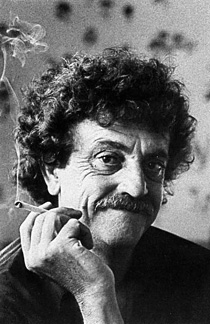
Kurt Vonnegut Jr. & Cat's Cradle

Kurt Vonnegut, Jr. (November 11, 1922 – April 11, 2007) was an American novelist known for works blending satire, black comedy, and science fiction, such as Slaughterhouse-Five (1969), Cat's Cradle (1963), and Breakfast of Champions (1973). Read about him here.

Vonnugut’s Advice On Writing

On pages 9 and 10 of his book Bagombo Snuff Box: Uncollected Short Fiction, Vonnegut listed eight rules for writing a short story:
1. Use the time of a total stranger in such a way that he or she will not feel the time was wasted.
2. Give the reader at least one character he or she can root for.
3. Every character should want something, even if it is only a glass of water.
4. Every sentence must do one of two things — reveal character or advance the action.
5. Start as close to the end as possible.
6. Be a sadist. No matter how sweet and innocent your leading characters, make awful things happen to them — in order that the reader may see what they are made of.
7. Write to please just one person. If you open a window and make love to the world, so to speak, your story will get pneumonia.
8. Give your readers as much information as possible as soon as possible. To heck with suspense. Readers should have such complete understanding of what is going on, where and why, that they could finish the story themselves, should cockroaches eat the last few pages.
Vonnegut qualifies the list by adding that the greatest American short story writer, Flannery O'Connor, broke all these rules except the first, and that great writers tend to do that.

In Chapter 18 of his book Palm Sunday "The Sexual Revolution," Vonnegut grades his own works. He states that the grades "do not place me in literary history" and that he is comparing "myself with myself." The grades are as follows:
• Player Piano: B
• The Sirens of Titan: A
• Mother Night: A
• Cat's Cradle: A-plus
• God Bless You, Mr. Rosewater: A
• Slaughterhouse-Five: A-plus
• Welcome to the Monkey House: B-minus
• Happy Birthday, Wanda June: D
• Breakfast of Champions: C
• Slapstick: D
• Jailbird: A
• Palm Sunday: C

Cowboys Are My Weakness Review/Draft

A. Please turn in your book review today if you have not already done so.

B. Work today to create a short story (25-5,000 words) in the style of Pamela Houston.

C. Pick up Cat's Cradle by Kurt Vonnegut, Jr. and begin reading this book. (See post above this one).

Pamela Houston Story:
--It can be a romance
--It can be a western
--It can be chick lit (a story whose audience is: female)
--It can be a parody
--It can be about characters/plots/themes similar to those you read in Houston's collection
1. Put the story in the same or similar setting.
2. Use a similar theme (broken romance, for example), but change location and character types
3. Use a similar style, such as POV or sentence structure, but feel free to change character types, styles, and settings.
4. Use a similar plot element. If you are writing micro fiction or hint fiction, use only a single event. If you want to write something longer, use a similar plot element, but perhaps rearrange the story to make it your own.
5. Use a similar character.
6. Write the next chapter of the story you selected. What happens in one year? What happens in 10 years? What happens during a flood or earthquake? After writing the story, change the names if you'd like.

Work on your draft today in class.

HOMEWORK: Begin reading Cat's Cradle. Review the information about Kurt Vonnegut, Jr. above. Bring your books with you to class on Friday. Complete your Pamela Houston draft if you didn't finish today.

Sunday, April 15, 2012

Cowboys Are My Weakness: Review

Use the lab today to write your book review. See April 2 post for details.

If you complete your book review, try writing a story in the style of Pamela Houston. Take your favorite story from the collection and do any of the following:

1. Put the story in the same or similar setting.
2. Use a similar theme (broken romance, for example), but change location and character types
3. Use a similar style, such as POV or sentence structure, but feel free to change character types, styles, and settings.
4. Use a similar plot element. If you are writing micro fiction or hint fiction, use only a single event. If you want to write something longer, use a similar plot element, but perhaps rearrange the story to make it your own.
5. Use a similar character.
6. Write the next chapter of the story you selected. What happens in one year? What happens in 10 years? What happens during a flood or earthquake? After writing the story, change the names if you'd like.

Work on your draft. When completed, bring it to workshop. Print it out eventually and place in your portfolio for this marking period's grade.

HOMEWORK: If you do not complete your book review, please complete it as homework. If you did not start or begin the fiction draft, please do so for homework.

About this course!

This course stresses understanding the characteristics & techniques in the literary genres of fiction, poetry, and dramatic writing. This course will continue to build on students’ reading and writing skills begun in previous creative writing classes. Readings and discussions of works by major writers in the field will be examined as inspiration and models of fine writing. This educational blog is designed for the use of the students at the School of the Arts in Rochester, NY.