Friday, April 20, 2012

Revisions & Cat's Cradle

During period 7, we will be discussing and reading Cat's Cradle. Please read silently for the next 10-15 minutes. As you read, please take notes on the handout. After our activities, we will return to the lab.

Please take a moment today to review the tips Vonnegut gives us about writing.

1. Use the time of a total stranger in such a way that he or she will not feel the time was wasted.
2. Give the reader at least one character he or she can root for.
3. Every character should want something, even if it is only a glass of water.
4. Every sentence must do one of two things — reveal character or advance the action.
5. Start as close to the end as possible.
6. Be a sadist. No matter how sweet and innocent your leading characters, make awful things happen to them — in order that the reader may see what they are made of.
7. Write to please just one person. If you open a window and make love to the world, so to speak, your story will get pneumonia.
8. Give your readers as much information as possible as soon as possible. To heck with suspense. Readers should have such complete understanding of what is going on, where and why, that they could finish the story themselves, should cockroaches eat the last few pages.

Use at least one of these tips to revise a previous draft for your portfolio. This advice can also apply to poetry.

If you didn't finish your Houston draft, please use the time in the lab to complete this assignment. Otherwise, you are free to continue reading Cat's Cradle.

HOMEWORK: Read Cat's Cradle. Complete any missing or late work. Begin preparing your portfolio.

Wednesday, April 18, 2012

Kurt Vonnegut Jr. & Cat's Cradle

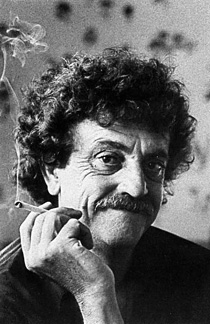
Kurt Vonnegut, Jr. (November 11, 1922 – April 11, 2007) was an American novelist known for works blending satire, black comedy, and science fiction, such as Slaughterhouse-Five (1969), Cat's Cradle (1963), and Breakfast of Champions (1973). Read about him here.

Vonnugut’s Advice On Writing

On pages 9 and 10 of his book Bagombo Snuff Box: Uncollected Short Fiction, Vonnegut listed eight rules for writing a short story:
1. Use the time of a total stranger in such a way that he or she will not feel the time was wasted.
2. Give the reader at least one character he or she can root for.
3. Every character should want something, even if it is only a glass of water.
4. Every sentence must do one of two things — reveal character or advance the action.
5. Start as close to the end as possible.
6. Be a sadist. No matter how sweet and innocent your leading characters, make awful things happen to them — in order that the reader may see what they are made of.
7. Write to please just one person. If you open a window and make love to the world, so to speak, your story will get pneumonia.
8. Give your readers as much information as possible as soon as possible. To heck with suspense. Readers should have such complete understanding of what is going on, where and why, that they could finish the story themselves, should cockroaches eat the last few pages.
Vonnegut qualifies the list by adding that the greatest American short story writer, Flannery O'Connor, broke all these rules except the first, and that great writers tend to do that.

In Chapter 18 of his book Palm Sunday "The Sexual Revolution," Vonnegut grades his own works. He states that the grades "do not place me in literary history" and that he is comparing "myself with myself." The grades are as follows:
• Player Piano: B
• The Sirens of Titan: A
• Mother Night: A
• Cat's Cradle: A-plus
• God Bless You, Mr. Rosewater: A
• Slaughterhouse-Five: A-plus
• Welcome to the Monkey House: B-minus
• Happy Birthday, Wanda June: D
• Breakfast of Champions: C
• Slapstick: D
• Jailbird: A
• Palm Sunday: C

Cowboys Are My Weakness Review/Draft

A. Please turn in your book review today if you have not already done so.

B. Work today to create a short story (25-5,000 words) in the style of Pamela Houston.

C. Pick up Cat's Cradle by Kurt Vonnegut, Jr. and begin reading this book. (See post above this one).

Pamela Houston Story:
--It can be a romance
--It can be a western
--It can be chick lit (a story whose audience is: female)
--It can be a parody
--It can be about characters/plots/themes similar to those you read in Houston's collection
1. Put the story in the same or similar setting.
2. Use a similar theme (broken romance, for example), but change location and character types
3. Use a similar style, such as POV or sentence structure, but feel free to change character types, styles, and settings.
4. Use a similar plot element. If you are writing micro fiction or hint fiction, use only a single event. If you want to write something longer, use a similar plot element, but perhaps rearrange the story to make it your own.
5. Use a similar character.
6. Write the next chapter of the story you selected. What happens in one year? What happens in 10 years? What happens during a flood or earthquake? After writing the story, change the names if you'd like.

Work on your draft today in class.

HOMEWORK: Begin reading Cat's Cradle. Review the information about Kurt Vonnegut, Jr. above. Bring your books with you to class on Friday. Complete your Pamela Houston draft if you didn't finish today.

Sunday, April 15, 2012

Cowboys Are My Weakness: Review

Use the lab today to write your book review. See April 2 post for details.

If you complete your book review, try writing a story in the style of Pamela Houston. Take your favorite story from the collection and do any of the following:

1. Put the story in the same or similar setting.
2. Use a similar theme (broken romance, for example), but change location and character types
3. Use a similar style, such as POV or sentence structure, but feel free to change character types, styles, and settings.
4. Use a similar plot element. If you are writing micro fiction or hint fiction, use only a single event. If you want to write something longer, use a similar plot element, but perhaps rearrange the story to make it your own.
5. Use a similar character.
6. Write the next chapter of the story you selected. What happens in one year? What happens in 10 years? What happens during a flood or earthquake? After writing the story, change the names if you'd like.

Work on your draft. When completed, bring it to workshop. Print it out eventually and place in your portfolio for this marking period's grade.

HOMEWORK: If you do not complete your book review, please complete it as homework. If you did not start or begin the fiction draft, please do so for homework.

Wednesday, April 4, 2012

Everyday Poetry

This stuff called poetry...

Is not really that complicated. Poetry is about human existence. Even poems about objects or settings or events involve humans and their relationship with external forces. Of course a poem can ALSO be about a speaker's conflict (if any) of internal forces.

Poems are about us. We can either write about love, death/life, or nature. Writing about the self or ones beliefs or God or an event or locations or objects or animals falls into one of these three categories. 

So poems concern everyday things. To come up with subject matter for a poem is as easy as throwing a stone through the air and hitting the ground.

Poems can be about animals:
Poem idea: write about an animal or pet.
Whales Weep Not by D.H. Lawrence
Baby Tortoise by D.H. Lawrence
The Dusk of Horses by James Dickey
A Crocodile by Thomas Lovell Beddoes
Bats by Paisley Rekdal
Common items:

Poem idea: Write about an article of clothing. Clothing indicates character by association.
Shirt by Robert Pinsky
Fat Southern Men in Summer Suits by Liam Rector
Red Slippers by Amy Lowell
The Lanyard by Billy Collins
Objects (or places) in our lives can become metaphors for us. Objects can be metaphors for made up speakers of poems. The object and how it is used is often related to CHARACTER.

Poem idea: you guessed it, write about an object or place that represents the speaker.
Quilt by Nikki Giovanni
Night Funeral in Harlem by Langston Hughes
Chicago by Carl Sandburg
Trapeze by Deborah Digges
 and People:
Aunt Jennifer's Tigers by Adrienne Rich
Miniver Cheevy by Edwin Arlington Robinson
The Ghazal of What Hurt by Peter Cole
Buddha With a Cell Phone by David Romtvedt

 Poetry appreciation workshop:

Take 15 minutes to search online for a poem or favorite poet and print out one of these favorite poems or a poem from a favorite author. Bring it to you workshop group during 8th period and share your favorite poem with each other. Discuss what you like about the poem. No negatives here. If you didn't like the poem--smile and nod.

HOMEWORK: Feel free to read or write whatever you'd like during break. No assigned homework.

Monday, April 2, 2012

Nature Poetry

Much of poetry involves nature.

What is a nature poem?: A poem in which nature plays an important role, emphasizing terrain and life (including the life of humans) in a natural setting, season, metaphor, symbol, situation or theme.

Types of Nature Poetry

1. Tribute to the season: (Ode/Pastoral) – Praising or welcoming a season.
• Nature-Human Celebration: The poet or speaker celebrates himself or herself as part of nature.
• Essence of Nature: An aspect or element of nature is described (usually to show its beauty or essence)

2. Nature as conflict:
• Nature against human. A man or woman is in a dangerous or difficult situation concerning nature.
• Human against nature: A man or woman overcoming a dangerous situation or destroying some aspect of nature.
• Isolation from Nature: The speaker describes how he or she feels apart from nature or the natural world.

3. Human-nature Relationship: A person who contemplates (thinks about) some aspect of nature. Often the speaker is longing for nature’s qualities.
• Human encountering nature: The speaker witnesses or beholds an element or aspect of nature as if for the first time (the speaker is “in the moment” and acutely aware).
• Nature as Reflection of Mood: The setting is usually out doors and the speaker describes a feeling. Nature or natural images reflect the mood of the speaker.
• Nature as Metaphor for the Human Condition: The poet makes a comparison between human qualities or subject matter and some aspect or element of nature (usually to express how it feels to be mortal or at peace).
• Nature as Symbolic of the Human Condition: Like the Metaphor poem (above), it uses a symbol instead of a metaphor.

4. Nature as a Reflection of God: Another common nature poem type. Some aspect or element of nature shows or reminds the speaker of God’s power or artistry.

Forms:

• Ode: an open poem form that praises its subject (in this case something in nature)
• Elegy: an open poem form that laments or mourns a subject that is gone or passed away (this can also be found in love poetry).
• Pastoral: An open nature poem form in which rural life or objects are romanticized or idealized.

Classwork: Write an ode, elegy, or pastoral.

Book Review: Cowboys Are My Weakness

There is no right way to write a book review. Book reviews are highly personal and reflect the opinions of the reviewer. A review can be as short as 100 words, or as long as 1,500 words, depending on the purpose of the review.

The following are standard procedures for writing book reviews; they are only suggestions. Generally for magazines, the reviewer will have a biased slant due to audience. For example, a feminist magazine may take a feminist look at the work in question. Writing for a science fiction magazine about a romance novel might criticize the book with a bias. Be aware of this kind of bias when you read (and write) reviews. 

Generally, the process is as follows:
1. Write a statement giving essential information about the book: title, author, first copyright date, type of book, general subject matter, special features (maps, color plates, etc.), price and ISBN where appropriate. Since we are all using the same edition, don't worry too much about ISBN or price (it's out of date).

2. State the author’s purpose in writing the book. Sometimes authors state their purpose in the preface or the first chapter. When they do not, you may arrive at an understanding of the book’s purpose by asking yourself these questions:
a. Why did the author write on this subject rather than on some other subject?
b. From what point of view is the work written?
c. Was the author trying to give information, to explain something, to convince the reader, or to entertain?
d. What is the general field or genre, and how does the book fit into it? Knowledge of the genre means understanding the form and how it functions. Is this book a science fiction romance or a paranormal teen novel? For collections of short fiction like this consider the stories as a collection.
e. Who is the intended audience?
f. What is the author's style? Is it formal or informal? Evaluate the quality of the writing style by using some of the following standards: coherence, clarity, originality, forcefulness, correct use of technical words, conciseness, fullness of development, fluidity. Does it suit the intended audience and how might the author do that?
g. Scan the Table of Contents, it can help understand how the book is organized and will aid in determining the author's main ideas and how they are developed - chronologically, topically, etc.
g. How did the book affect you? Were any previous ideas you had on the subject changed, abandoned, or reinforced due to this book? How is the book related to your own course or personal agenda? What personal experiences you've had relate to the subject?
h. How well has the book achieved its goal?
i. Would you recommend this book or article to others? Why?
3. State the theme and the thesis of the book.
a. Theme: The theme is the subject or topic. It is not necessarily the title, and it is usually not expressed in a complete sentence. It expresses a specific phase of the general subject matter. In this collection why name the book after the specific story? (consider audience)
b. Thesis: The thesis is an author’s generalization about the theme, the author’s beliefs about something important, the book’s philosophical conclusion, or the proposition the author means to prove. Express it without metaphor or other figurative language, in one declarative sentence.
Example
Title: Alice's Misadventures Underground
General Subject Matter: Literary satire, parody, and humor
Theme: The corruption of youth
Thesis: Adults corrupt the young with their ideas and schemes.
4. Development. How does the author support her thesis?
a. Description: The author presents word-pictures of scenes and events by giving specific details that appeal to the five senses, or to the reader’s imagination. Description presents background and setting. Its primary purpose is to help the reader realize, through as many sensuous details as possible, the way things (and people) are, in the episodes being described.
b. Narration: The author tells the story of a series of events, usually presented in chronological order. In a novel however, chronological order may be violated for the sake of the plot. The emphasis in narration, in both fiction and non-fiction, is on the events. Narration tells what has happened. Its primary purpose is to tell a story.
c. Exposition: The author uses explanation and analysis to present a subject or to clarify an idea. Exposition presents the facts about a subject or an issue as clearly and impartially as possible. Its primary purpose is to explain.
d. Argument: The author uses the techniques of persuasion to establish the truth of a statement or to convince the reader of its falsity. The purpose is to persuade the reader to believe something and perhaps to act on that belief. Argument takes sides on an issue. Its primary purpose is to convince.
5. Evaluate the book for interest, accuracy, objectivity, importance, thoroughness, and usefulness to its intended audience. Show whether the author's main arguments are true. Respond to the author's opinions. What do you agree or disagree with? And why? Explore issues the book raises. Compare it with other books on similar subjects or other books by the same as well as different authors. Comment on parts of particular interest, and point out anything that seems to give the book literary merit. Relate the book to larger issues.

6. Try to find further information about the author - reputation, qualifications, influences, biographical, etc. - any information that is relevant to the book being reviewed and that would help to establish the author's authority. Can you discern any connections between the author's philosophy, life experience and the reviewed book?
If your thesis has been well argued, the conclusion should follow naturally. It can include a final assessment or simply restate your thesis. Do not introduce new material at this point.
What to examine when reading and writing a fiction review: 
Character
1. From what sources are the characters seemingly drawn?
2. What is the author's attitude toward her characters?
3. Are the characters flat and stereotypical or three-dimensional and dynamic?
Theme
1. What is/are the major theme(s)?
2. How are they revealed and developed?
3. Is the theme traditional and familiar, or new and original?
4. Is the theme didactic, psychological, social, entertaining, escapist, etc. in purpose or intent?
Plot
1.How are the various elements of plot (eg, introduction, suspense, climax, conclusion) handled? In a collection, consider the placement of stories in the collection.
Style
1. What are the "intellectual qualities" of the writing (e.g., simplicity, clarity)?
2. What are the "emotional qualities" of the writing (e.g., humour, wit, satire)?
3. What are the "aesthetic qualities" of the writing (e.g., harmony, rhythm)?
4. What stylistic devices are employed (e.g., symbolism, motifs, parody, allegory)?
5. How effective is dialogue?
Setting
1. What is the setting and does it play a significant role in the work?
2. Is a sense of atmosphere evoked, and how?
3. What scenic effects are used and how important and effective are they?
4. Does the setting influence or impinge on the characters and/or plot?
Further: Book Review advice

CLASS/HOMEWORK: Read the book. Consider these questions and tips when reading. Take notes on the stories you read.

Your book report will be longer and more involved depending on the kind of grade you want. If reviewing the whole book, the review should make it clear that the whole book was considered and examined closely in the review. If you opt for the lower grades, the length of your review will undoubtedly vary with complexity. See previous posts for details.

About this course!

This course stresses understanding the characteristics & techniques in the literary genres of fiction, poetry, and dramatic writing. This course will continue to build on students’ reading and writing skills begun in previous creative writing classes. Readings and discussions of works by major writers in the field will be examined as inspiration and models of fine writing. This educational blog is designed for the use of the students at the School of the Arts in Rochester, NY.